It's Saturday evening and you're wondering whether the cold room is holding the right temperature. To find out, you have to go there in person. And if you want to change it, the same: the controller can only be set from its panel, on site.
That's where a project we've just completed started, for a food company with cold rooms in a logistics hub. Here we explain what we did, what changed in day-to-day work, and in which other cases the same solution can be adapted.
In short
- The existing controller stays where it is: no work on the refrigeration system.
- The temperature changes by itself, following a weekly schedule by day and time.
- From a phone or PC you can check and adjust the cold room from anywhere, with protected access.
- The temperature is logged every minute and kept for 24 months.
- If the power goes off or the controller stops responding, an alarm call goes out.
The problem: a cold room you can only run from its panel
The cold rooms were run by Pego controllers from the ECP series. They did their job well, but to change the set temperature (the so-called set point) someone had to stand in front of the panel and do it by hand.
That created three concrete limits:
- No scheduling. If a different temperature was needed on certain days or at certain hours, someone had to remember to change it, and then to put it back.
- No remote control. Outside working hours there was no way of knowing how the cold room was doing, or of stepping in.
- No memory. Without an automatic log it was hard to tell what had happened overnight or at the weekend: you could only see the current reading.
None of these problems stopped the work. Taken together, though, they meant depending on someone being on site and on their memory.
The solution: a small box next to the switchboard
Replacing the controllers would have meant shutting down the cold rooms and reworking the refrigeration system. We went the other way: leave everything as it was and add one piece.
Next to the electrical switchboard we fitted a small box. Inside is a mini-computer (a Raspberry Pi, a compact board widely used in small automation systems) connected to the controller with a Modbus data cable: in practice, the language many professional controllers use to accept commands and report readings.
The controller keeps doing what it has always done, which is holding the cold room at temperature. The mini-computer tells it which temperature to hold and records what happens.
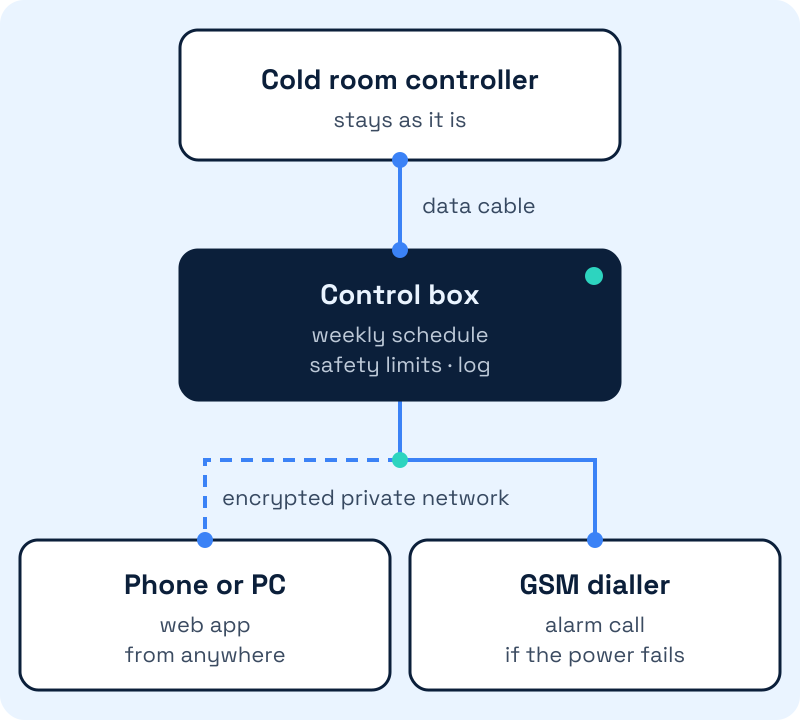
The process was the same as for every project of ours: site visit, design, assembly of the box, installation together with the client's electrician, and on-site acceptance testing. The test was passed, the system is in operation, and the software comes with a 12-month warranty.
What changes every day
The temperature follows the calendar
You set a weekly schedule with time slots: for each day and each time of day you decide the temperature. From then on the system changes it by itself, without anyone having to remember.
The cold room is controlled from your phone
A web app, meaning an application that opens in the phone's or PC's browser with nothing to install, shows the temperature and lets you change it. If you need an exception, you set a different value by hand; one click takes you back to the schedule.
Remote access goes through an encrypted private network: only authorised devices can connect, and the box has no ports open to the Internet.
A typo doesn't become a problem
The system has safety limits: it won't set temperatures outside the permitted range. If someone types the wrong value by mistake, the command doesn't go through.
You can see what happened, even at night
The temperature is logged every minute and kept for 24 months. A chart lets you scroll through the days and see at a glance how the night or the weekend went.
There's also an event log, which can be exported as a CSV file that opens in Excel or any spreadsheet.
If the power goes off, someone knows
The system detects a power failure and places an alarm call through a GSM dialler, a small device with a SIM card that calls a preset number by itself. The same happens if the controller stops responding.
The mini-computer is connected to an uninterruptible power supply (UPS) and has an internal battery-backed clock: after an outage the schedule stays correct, with nothing to reset.
Who it's for
The case we handled involves a food company, but the problem is the same wherever there's a cold room or professional fridge that can only be set from its panel. The solution can be adapted, for example, to:
- restaurants and delis, where cold rooms work differently on opening and closing days;
- food production workshops, which need to know how storage went during unstaffed hours;
- cold chain logistics, with several cold rooms to keep an eye on from a distance;
- pharmacies with fridges for products that must be stored at a controlled temperature;
- storage cold rooms in general, wherever today the temperature can only be checked by going on site.
Every installation is different: before proposing anything we visit the site and check that your controller can talk to the system.
Frequently asked questions
Do I have to replace my controller?
If it's compatible, no. The system connects to the one you already have and lets it work as before: no work on the refrigeration system.
Does it work with my brand?
We built and tested it on Pego ECP series controllers. Many other controllers have similar communication ports, but compatibility has to be checked case by case, on the model you have.
Is remote access secure?
Access goes through an encrypted private network reserved for authorised devices, and the box has no ports open to the Internet. On top of that, the safety limits prevent temperatures outside the permitted range from being set, remotely too.
What happens if the power goes off?
The system detects the outage and places the alarm call. The mini-computer is protected by a UPS, and the battery-backed internal clock keeps the right time: when the power comes back, the schedule resumes correctly.
Does it help with HACCP?
The system logs the temperature every minute and keeps it for 24 months: a useful basis for your checks. Today there's no automatic link to your company records; integration with HACCP systems can be developed on request. How to use this data in your food safety plan should be assessed with your HACCP consultant.
Want to know more?
If your cold rooms can also only be set from the panel, tell us how you work. Fill in the contact form for more information: we'll get back to you and, if needed, arrange a site visit to check your controller.